
Pump Sizing, NPSH & Pump Curve Analysis: A Guide to Pump Selection and Energy Efficiency
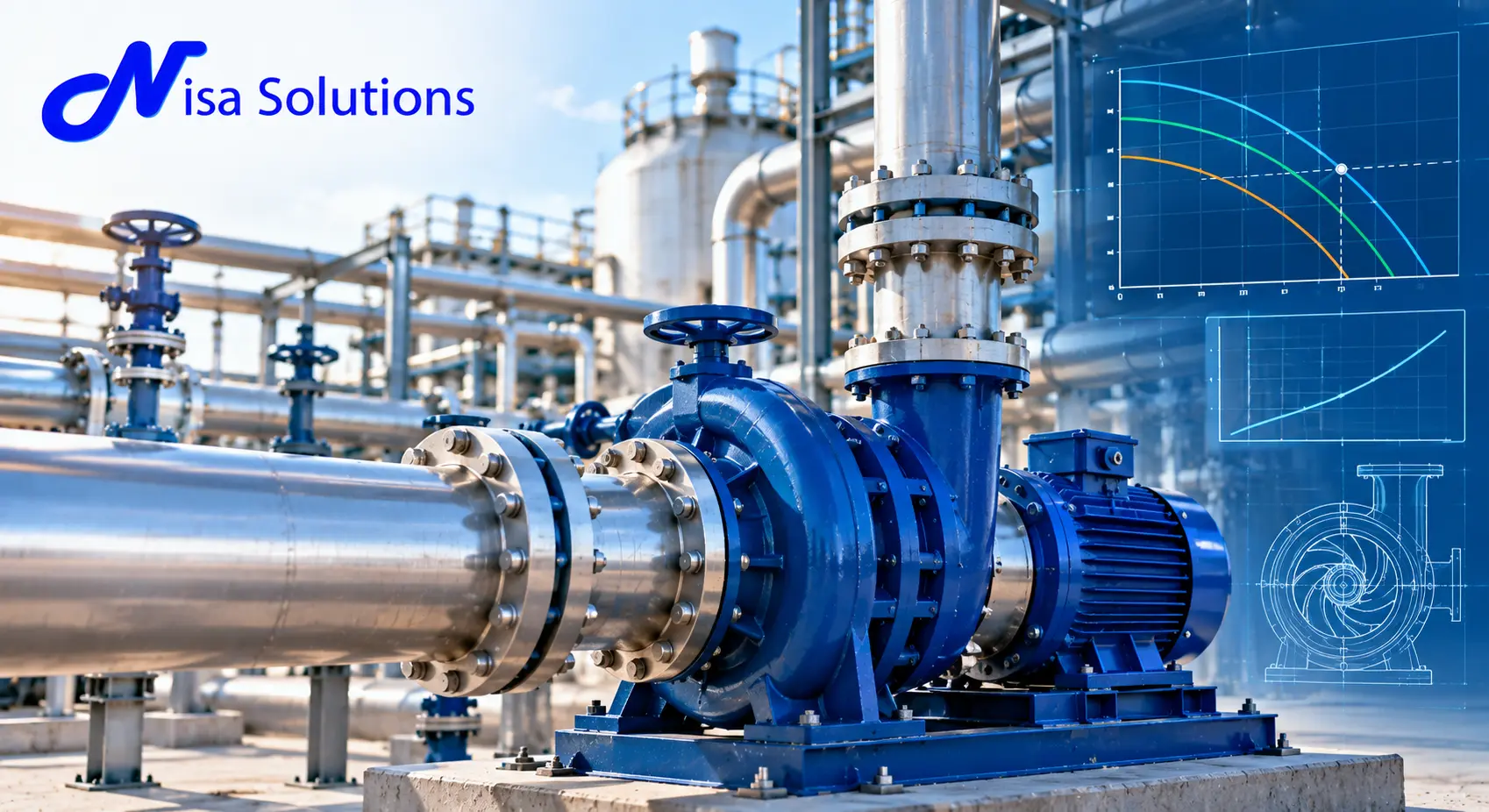
An incorrectly sized pump can result in insufficient flow, excessive pressure, inefficient operation, or difficulties during commissioning.
Pump selection requires more than choosing equipment based on flow rate alone. Engineers must evaluate the hydraulic requirements of the complete piping system, including friction losses, elevation differences, operating conditions, pump performance curves, and suction-side requirements.
This guide explains the fundamentals of pump sizing, pump curve analysis, and net positive suction head (NPSH), and explores how pump sizing software and hydraulic modeling can support engineering decisions.
What Is Pump Sizing?
Pump sizing is the engineering process of determining the pump capacity and performance requirements needed to deliver a specified flow under the expected operating conditions of a fluid system.
The process involves evaluating the system’s required flow rate and total dynamic head, then identifying a pump capable of meeting those requirements.
For a complete piping system, pump sizing must consider the resistance created by pipes, fittings, valves, equipment, and elevation changes.
A pump selected without evaluating these conditions may not operate at the intended flow or may consume more energy than necessary.
What Is Total Dynamic Head (TDH)?
Total dynamic head represents the total head that a pump must provide to move fluid through a system at a specified flow rate.
It includes the relevant static head difference, pressure requirements, and hydraulic losses associated with the system.
In a typical liquid pumping application, total dynamic head may include:
Static elevation difference between the source and destination.
Pressure difference between the system’s suction and discharge boundaries.
Friction losses in the suction and discharge piping.
Additional losses across valves, fittings, heat exchangers, and other components.
The actual terms included depend on the system configuration and the selected reference points.
Total dynamic head is commonly expressed in units of length of the pumped fluid, such as metres or feet.
Understanding TDH is important because the pump must provide sufficient head at the required flow rate to satisfy the system’s operating conditions.
How to Select the Right Pump for a Piping System
Pump selection should begin with the hydraulic requirements of the system rather than the pump model alone.
1. Determine the Required Flow Rate
Establish the flow rate required by the process, equipment, or distribution network.
The design flow should reflect the intended operating conditions and any relevant variations in demand.
For systems with multiple operating cases, engineers should evaluate the flow requirements for each important condition.
2. Calculate the System Head Requirement
Evaluate the static head, pressure requirements, and friction losses across the complete system.
The system head requirement generally changes with flow rate because frictional losses increase as flow changes.
For interconnected piping systems, a network-level hydraulic analysis can help determine the flow distribution and the corresponding head requirement.
3. Evaluate Pump Performance
Compare the system requirements with the pump’s performance data.
A pump must deliver the required flow and head within its acceptable operating range and under the expected fluid conditions.
Pump performance curves provide the information needed to evaluate this relationship.
4. Check Suction Conditions
Confirm that sufficient net positive suction head is available at the pump inlet to meet the pump manufacturer’s requirements.
Suction-side pressure losses, liquid temperature, fluid vapor pressure, elevation, and tank pressure can influence the available NPSH.
5. Evaluate Operating Conditions
Consider pump efficiency, motor input power, operating conditions, and anticipated variations in demand.
Evaluating these factors alongside the hydraulic requirements helps engineers assess the overall performance of the pumping system.
Pump Curve Analysis: Understanding Pump Performance
A pump performance curve describes the relationship between a pump’s flow rate and its operating characteristics.
Common pump curves include:
Flow rate versus head.
Flow rate versus efficiency.
Flow rate versus power.
Flow rate versus required net positive suction head.
These curves are generally provided by pump manufacturers for specified equipment and operating conditions.
What Is the Pump Operating Point?
The operating point is determined by the intersection of the pump’s performance curve and the system’s hydraulic requirement, commonly represented by a system curve.
At this point, the head developed by the pump matches the head required by the system at the resulting flow rate.
If the system resistance changes, the operating point may also change.
For example, changes in valve positions, piping configuration, fluid properties, or connected equipment can affect system resistance and influence the pump’s operating conditions.
Pump curve analysis software can help engineers evaluate these relationships by incorporating pump performance data into a piping system model.
Why Is Pump Curve Analysis Important?
Pump curve analysis helps engineers assess whether a selected pump can meet the required operating conditions.
It can also help identify situations where a pump may be oversized, operating inefficiently, or working outside its intended performance range.
For systems with varying flow requirements, engineers may need to consider multiple operating cases rather than evaluating only one design point.
This makes it important to consider pump performance within the complete piping system.
Centrifugal Pump Sizing and Selection
Centrifugal pumps are widely used in industrial fluid handling, water circulation, cooling systems, and process applications.
A centrifugal pump transfers energy to a fluid through a rotating impeller. Its performance depends on the pump design, rotational speed, fluid properties, and system operating conditions.
Centrifugal pump sizing requires an understanding of the required flow, total dynamic head, pump performance curve, and suction conditions.
Key Factors in Centrifugal Pump Sizing
Required flow rate: The volume of fluid the system must deliver under the intended operating conditions.
Total dynamic head: The head needed to overcome static requirements and hydraulic resistance.
Pump efficiency: The relationship between hydraulic output and the power supplied to the pump.
Operating range: The range of flow and head conditions within which the pump can operate appropriately.
Suction requirements: The available suction conditions must satisfy the pump’s NPSH requirements.
A centrifugal pump sizing tool can help engineers evaluate candidate pump performance against the system requirements.
However, the final pump selection should also consider manufacturer data, mechanical requirements, materials, fluid compatibility, and the applicable engineering specifications.
NPSH Calculation: Understanding Pump Suction Requirements
Net positive suction head (NPSH) is an important consideration in pump selection and hydraulic system design.
It relates to the pressure or energy available at the pump suction relative to the vapor pressure of the pumped liquid.
Insufficient suction conditions can cause the local pressure to fall below the liquid’s vapor pressure, resulting in vapor bubble formation and potentially damaging cavitation.
Two important NPSH terms are used in pump engineering.
Net Positive Suction Head Available (NPSHa)
NPSHa represents the net positive suction head available from the system at the pump suction.
It depends on the system’s suction-side conditions, including:
Pressure above the liquid surface in the supply vessel.
Liquid elevation relative to the pump.
Fluid density and vapor pressure.
Pressure losses in the suction piping and associated components.
Higher suction-side losses can reduce the NPSH available to the pump.
Net Positive Suction Head Required (NPSHr)
NPSHr is a pump performance characteristic determined through manufacturer testing.
It represents the pump’s required suction head under specified test conditions and flow rates.
The required value varies with pump design and operating conditions.
NPSHa vs. NPSHr
For a pump to operate within the applicable suction requirements, the available NPSH must satisfy the manufacturer’s required value and the project’s specified requirements.
The appropriate difference between NPSHa and NPSHr depends on the pump, operating conditions, manufacturer recommendations, and applicable engineering standards.
Engineers should evaluate the available NPSH across the intended operating range rather than considering only one operating point.
NPSH calculation software can help evaluate suction-side system conditions and compare the available NPSH with pump requirements.
PIPE-FLO’s documented hydraulic calculation capabilities include NPSH calculations and evaluation of piping system conditions relevant to pump selection.
Pump Energy Efficiency Analysis
Pump energy efficiency analysis evaluates how effectively the pumping system uses energy to deliver the required fluid flow and pressure.
The pump itself is only one part of the system. Piping friction, control valves, equipment resistance, and operating conditions can all influence the total power required.
A pump operating at a suitable efficiency does not necessarily mean the entire system is operating efficiently.
For example, a system may use a throttling valve to regulate flow. Depending on the application, the valve can dissipate a portion of the energy supplied by the pump.
Evaluating the entire system helps engineers understand where energy is being used and where losses occur.
Factors Affecting Pumping System Energy Consumption
Pump efficiency: Pump efficiency affects the input power required to deliver a given hydraulic output.
System resistance: Piping or component resistance influences the head requirement.
Pump selection: A pump that does not match the system requirements may operate away from its preferred efficiency range.
Control strategy: Throttling, variable-speed operation, and other control methods affect operating conditions and energy consumption.
Operating conditions: Variations in flow requirements and system configuration influence pump operation.
How Hydraulic Modeling Supports Energy Evaluation
Hydraulic modeling allows engineers to evaluate how changes to pumps, pipes, valves, and operating conditions influence system performance.
PIPE-FLO’s official technical material describes the analysis of energy supplied by pumps and losses associated with process and control elements. Its System Power Cost feature is documented as a means of examining the operating power and cost associated with modeled components.
For a technical assessment, the relevant engineering focus is the distribution of power and the relationship between pump performance and system resistance.
The official PIPE-FLO material also describes evaluating alternative pumps and variable-speed arrangements within a modeled system to compare operating scenarios.
Actual system performance depends on the configuration, equipment characteristics, operating schedule, and assumptions used in the analysis.
How Pump Sizing Software Supports Engineering Decisions
Pump sizing software combines hydraulic system calculations and equipment performance data to support the engineering process.
Instead of treating the pump as an isolated component, a system-based approach evaluates the pump within the piping network.
This is particularly useful when the system contains multiple pumps, parallel branches, control valves, interconnected equipment, or changing operating requirements.
PIPE-FLO for Pump Selection and Hydraulic Modeling
PIPE-FLO provides a piping-system modeling environment for analyzing flow rates, pressures, and the interaction between pumps and connected components.
Its documented capabilities include pump selection calculations, total dynamic head, NPSH, pump performance evaluation, and hydraulic network analysis.
The software can incorporate pump performance data and evaluate the resulting system operating conditions within the model.
For engineering teams, this approach can support design evaluation, equipment selection, troubleshooting, and assessment of operating scenarios.
Learn more about PIPE-FLO pump selection, sizing and hydraulic modeling software from NISA Solutions.
Common Pump Sizing and Selection Mistakes
Avoiding common mistakes can improve the quality of pump selection and system analysis.
Selecting a Pump Based Only on Flow Rate
Flow rate alone is not enough to determine whether a pump will meet the system requirements.
The required head and the pump’s performance curve must also be evaluated.
Ignoring the Complete Piping Network
A pump’s operating conditions depend on the resistance of the system in which it operates.
Isolated calculations may not capture the interactions between interconnected pipelines, valves, and equipment.
Overlooking NPSH Requirements
Inadequate suction conditions can lead to cavitation and operational problems.
NPSHa should be evaluated against the manufacturer’s NPSHr and the applicable requirements for the application.
Ignoring Variable Operating Conditions
A system may operate at different flow rates and configurations over its lifetime.
Evaluating only a single design point may not adequately represent the full range of operating conditions.
Evaluating Pump Efficiency in Isolation
Pump efficiency should be considered alongside system resistance, control methods, and operating requirements.
A complete system analysis can help identify where performance improvements may be possible.
Conclusion
Pump sizing, pump curve analysis, NPSH calculations, and energy evaluation are closely connected parts of fluid system engineering.
Selecting a suitable pump requires an understanding of the complete hydraulic system, including required flow, total dynamic head, suction conditions, and operating characteristics.
Hydraulic modeling software can help engineers evaluate these factors within a unified piping system model and compare alternative operating scenarios.
PIPE-FLO supports fluid flow analysis, pump selection, hydraulic modeling, and system performance evaluation for engineering teams working with complex piping systems.
Explore PIPE-FLO with NISA Solutions
Discover how PIPE-FLO can support pump selection, piping system analysis, and fluid system engineering.